


Why Higher MGO Manuka Honey is More Cost-Effective: Get Full Benefits Without Excess Sugar


When it comes to the world's most powerful superfoods, Manuka Honey from New Zealand is at the top of the list. However, with so many options ranging from low to high MGO ratings, many people wonder: How is a higher MGO better, and is it really worth the price?
This article explores the science, backed by real research, explaining why higher MGO allows you to consume less honey while still getting maximum benefits—saving you from a heavy sugar load.
Manuka Honey vs. Regular Honey: What is MGO?
Regular Honey: Gets its antibacterial properties from Hydrogen Peroxide, which is fragile and easily destroyed by heat, body enzymes, or sunlight.
Manuka Honey: Contains a unique natural active compound called Methylglyoxal (MGO), formed from Dihydroxyacetone (DHA) found in Manuka flower pollen.
The Magic of MGO: It is stable—meaning it doesn’t break down when exposed to heat or body enzymes. This is why Manuka honey has much stronger antibacterial, anti-inflammatory, and antioxidant properties than regular honey.
Fact-Check: Does Higher MGO Mean Eating Less While Getting the Same Benefits?
Short Answer: Yes, based on concentration-dependent efficacy.
According to lab studies, Manuka honey's ability to fight microbes and germs doesn't depend on the "mass of honey swallowed," but rather on the concentration of MGO that directly contacts the target bacteria or tissue.
Key Scientific Mechanisms:
Potency Scale: Studies show that high-MGO honey (like MGO 573+ or MGO 850+) can inhibit and destroy drug-resistant bacteria (like Staphylococcus aureus / MRSA) and gut bacteria like H. pylori using very small amounts.
The Problem with Low MGO: If you use low-MGO honey (e.g., MGO 30+) for therapeutic purposes, the target area won't receive enough active compounds, forcing you to eat much larger quantities to match the MGO level of a single spoonful of high-grade honey.
The Sugar Load: Honey is about 80% natural sugars (fructose and glucose). Eating huge amounts of low-MGO honey to get medicinal effects means flooding your body with excessive sugar and calories, which harms your blood sugar and dental health.
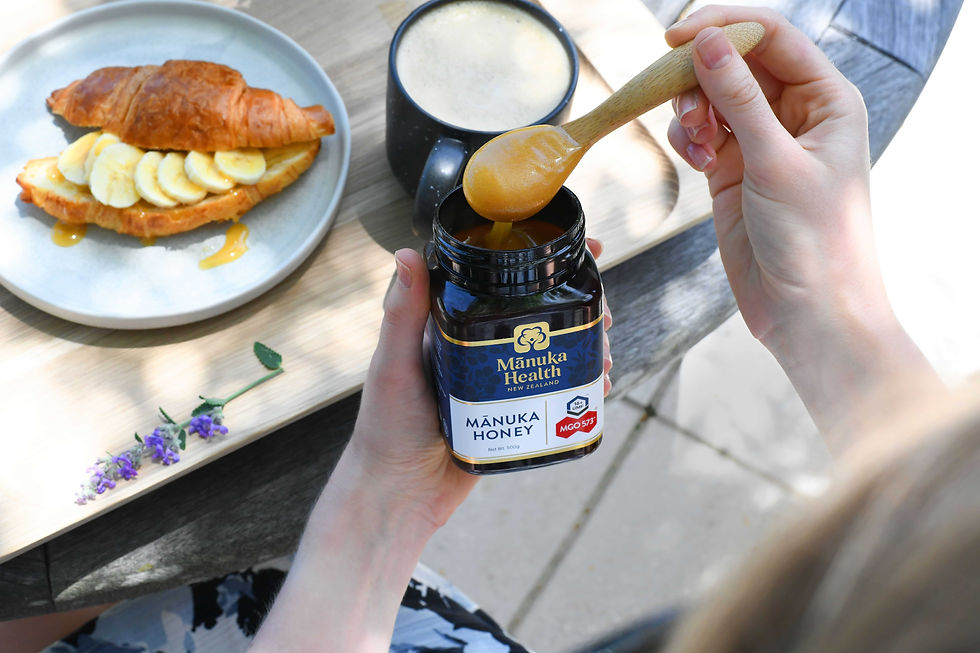
Conclusion: Choosing high-MGO Manuka honey allows you to limit your intake to just 1 teaspoon per day, giving you full potency without needing to gulp down half a jar.
Research Insights: Health Benefits of Higher MGO
Maximum Antibacterial Efficacy: Honey with MGO above 400–500 mg/kg quickly destroys bacterial cell walls, making it ideal for boosting immunity or managing digestive bacteria.
Digestive and Gut Health: MGO helps inhibit Helicobacter pylori (the bacteria causing stomach ulcers and chronic gastritis). High-MGO grades survive stomach acid effectively even in small doses.
Cellular Anti-Inflammatory Effects: High concentrations of phenolic compounds and polyphenols help suppress inflammatory pathways (such as NF-kB) efficiently per serving.
Quick MGO / UMF Selection Guide
MGO / UMF Level | Best Purpose | Recommended Daily Intake | Pros & Cons |
MGO 30+ to 115+ (UMF 5+ – 10+) | Everyday sweetener, general wellness, basic skin care | 1–2 tablespoons | Budget-friendly, but requires larger quantities for therapeutic results. |
MGO 263+ to 400+ (UMF 11+ – 12+) | Daily immunity support, soothing sore throats or mild coughs | 1 teaspoon – 1 tablespoon | Balanced price and performance for general daily use. |
MGO 573+ to 1000+ (UMF 15+ – 20+) | Gut health management, targeted germ defense, fast recovery | 1 teaspoon (small amount) | Highly concentrated, requires minimal intake, protects blood sugar levels. |
Tips to Get the Most Out of High-MGO Manuka Honey
Let it melt slowly: For a sore throat or oral health, let 1 teaspoon dissolve slowly in your mouth without washing it down immediately with water.
Avoid extreme heat: While MGO is heat-stable, mixing it into boiling water can destroy other delicate vitamins and enzymes. Let your warm drink cool down a bit first.
Consistency is key: Taking a small amount consistently (e.g., 1 teaspoon every morning or before bed) benefits your digestive system far more than eating huge amounts all at once.
Conclusion
Choosing higher-MGO Manuka honey is a smart health investment for targeted antibacterial, digestive, and immune support. Most importantly, it spares your body from excess sugar and calories while delivering powerful results.
References:
Dr. Brad Stanfield (2026) - Manuka Honey: Benefits, Grading, Dosing, and Side Effects.
Koura Organics Scientific Case Studies of Manuka Honey - Antibacterial and Anti-inflammatory Mechanisms.
Biosota Organics (2026) - Manuka Honey and Gut Health: What the Research Actually Shows.



Comments